On 10 November I read a headline in the Spanish newspaper elEconomista saying that Deutsche Bank "admits" banks have lost control of finance, and that the next major crisis is forming in the shadows of the financial system. The story was based on a paper published a week earlier by the Deutsche Bank Research Institute, Why hasn't there been a major financial crisis in recent years?
The paper is far less dramatic than the headline. Its argument is that banks are much stronger than in 2008, that more and more financial activity now happens outside them, and that the next episode of stress may therefore start where it is harder to see. In the authors' words, risks often shift rather than disappear.
Deutsche Bank is not just an outside observer, either. Its latest annual report shows €25.9 billion of loans to private credit, the part of non-bank finance that worries regulators and investors the most.
This article is an introduction to the world of shadow banking for readers who are less familiar with it. It takes about twelve minutes, which I know is a lot to ask in the age of 30-second videos. In return, I have gathered the most accurate and up-to-date data I could find, and I hope it gives you a clear and realistic picture of the topic.
Back to basics: how a bank works
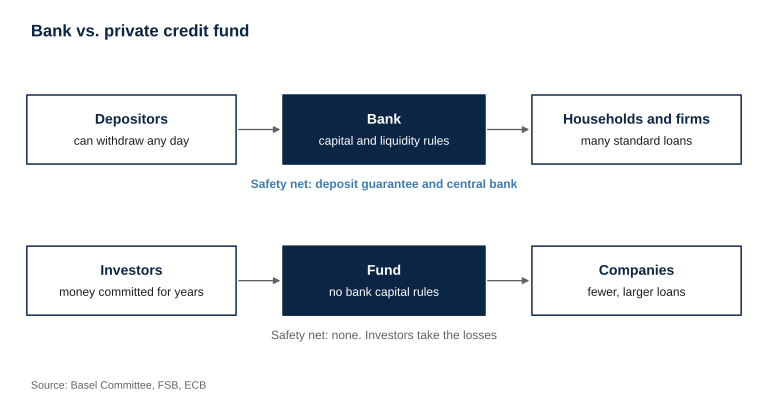
It may sound obvious, but the comparison only makes sense if we start with what a bank does. A bank takes deposits that you can withdraw at any moment and lends that money for years, as mortgages or business loans. This mismatch between short-term money and long-term loans is what makes banks useful, and also what makes them fragile: if all depositors ask for their money on the same day, no bank has it. Keep this idea in mind: the same mismatch is at the heart of today's concern about private credit.
That is why banks have a safety net: deposits are guaranteed up to a limit, and the central bank can lend to them in an emergency. In exchange, they are heavily regulated, and after 2008 they were made to hold much more capital and more liquid assets. Banks became safer. They also became a more expensive place to keep risky loans.
"Shadow banking" is the name for doing part of a bank's job, turning savings into loans, without being a bank. Regulators now prefer a more neutral name, non-bank financial intermediation, since most of it has nothing secret about it. A private credit fund, for example, collects money from insurers, pension funds and wealthy investors and lends it directly to companies. It takes no deposits, its investors have no public guarantee, and it does not have to hold capital the way a bank does. If it loses money, its investors take the loss.
How big is the world outside the banks?
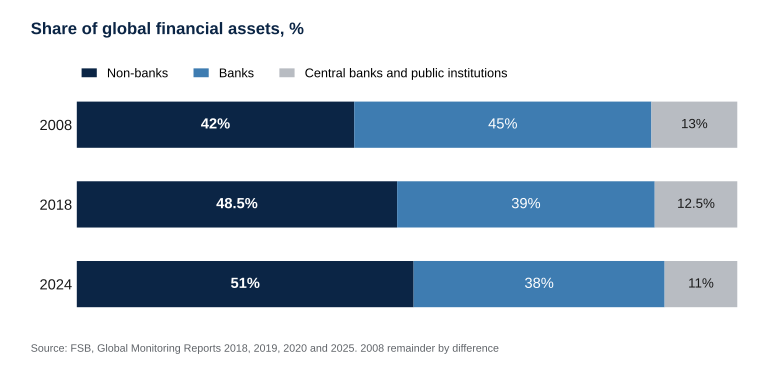
According to the Financial Stability Board (FSB), the body that monitors the financial system for the G20, non-banks held $256.8 trillion at the end of 2024: 51% of the financial assets in the economies it tracks, which make up more than 90% of world GDP. Banks held 38%. In 2024, non-banks grew twice as fast as banks.
Most of that money is not especially risky. It sits in pension funds, insurers and ordinary investment funds: if you own an index fund for your retirement, you are part of that 51% too. When a fund like that loses value, the loss stays with its investors.
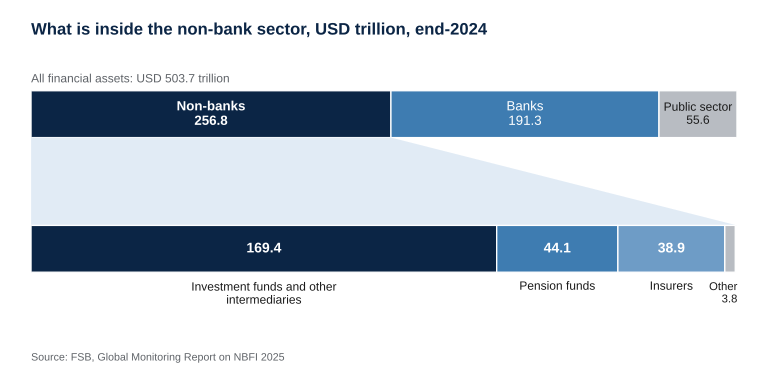
A non-bank becomes a danger for others in two cases: when it promises investors their money back faster than it can sell what it owns, which is the bank's mismatch again, or when it invests with borrowed money. That is what turned money market funds into a problem in 2008 and 2020, and UK pension funds in 2022. The FSB puts this riskier part at about 15% of the system.
Private credit, the part Deutsche Bank and almost everyone else is talking about, is much smaller: market estimates quoted by the FSB put it at $1.5 to 2 trillion. National authorities, however, could only find about $0.5 trillion in their own data. Even regulators cannot fully see this market.
What is private credit, and why did it grow so fast?
Private credit is a loan negotiated directly between a fund and a company, without a bank and without a bond market. The typical borrower is a mid-sized company, very often owned by a private equity firm, that would find it hard to borrow elsewhere.
The Federal Reserve gives three reasons for its growth: tighter rules for banks after 2008, the expansion of private equity, and the fact that these loans suit both sides. Companies get money quickly, on flexible terms and without sharing their accounts with a large group of lenders. Investors get high returns.
According to the Fed, the assets of private credit vehicles went from about $350 billion in 2012 to more than $2.6 trillion in 2025. This is a broader measure than the FSB's estimate, because it counts everything the funds hold. Private credit now provides around 6% of the debt of US companies, up from 1% in 2012.
Following the money
Here is the whole chain, from the people who put the money in to the companies that borrow it.
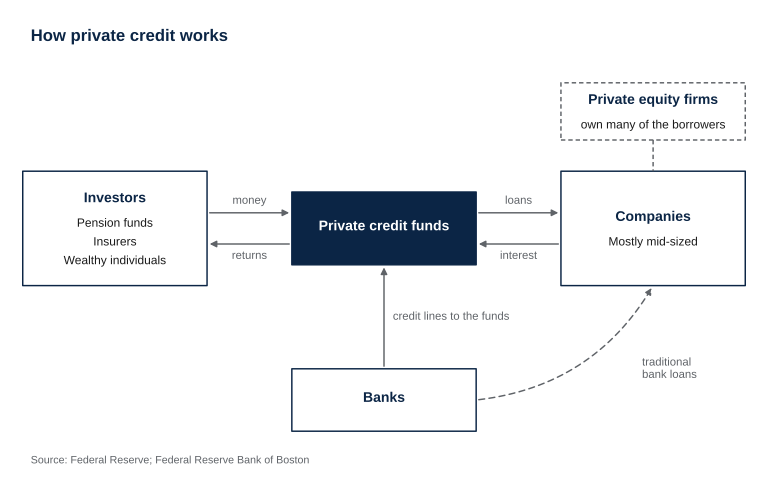
If these loans go bad, the loss falls on whoever put money into the funds. For the traditional funds, which lock investors in for years and are the ones the Fed can track in detail, the largest investors are pension funds for US public employees, followed by households and nonprofits, such as university endowments, and life insurers.
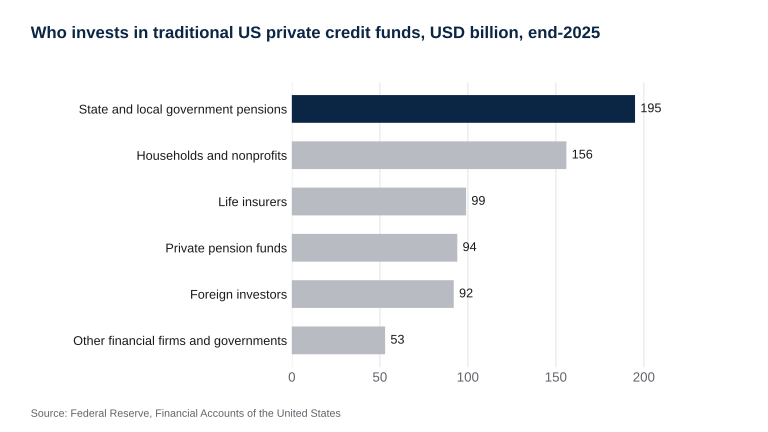
Public pension funds are natural investors here: they need steady returns to pay the pensions they have promised, and they can afford to lock money away for years. For them it is still a modest bet, about 3% of what they have invested.
Not every fund works this way, though. A newer kind, sold to wealthy individuals, lets investors ask for their money back every quarter. That is where the real concern lies.
Where the real concern lies
Regulators mostly agree that private credit is not a threat to the financial system today. The European Central Bank concluded in May that, on its own, it is unlikely to threaten financial stability in the euro area. Their concern is narrower, and it brings us back to the bank at the start of this article.
In the US, these newer funds usually take the form of a non-traded BDC (business development company), sold through financial advisers and private banks. Because the fund is not listed on a stock exchange, an investor cannot sell its shares to someone else. The only way out is to ask the fund to buy them back, which it allows once a quarter and usually up to 5% of the fund. So the fund has to find the cash, while its loans take years to be repaid. It is the bank's mismatch, without the bank's safety net.
If wealthy investors simply lost money in a private fund, it would be their problem, not the system's, and the IMF sees the impact as contained for now, because these funds are still a small part of the market. The worry is what a rush for the exit can set off. When withdrawals are capped, those who ask first are paid first, so the fear that others will leave becomes a reason to leave early. The IMF warns that selling these funds to individuals could make that race worse, and that closing the door on one fund can damage confidence in the whole industry, including funds that are doing well. And a fund that stops receiving new money also loses the cash it needs to keep lending, just when many of its borrowers will need to refinance.
Two other features make this more likely, and more costly.
Losses can show up late
The loans are not traded, so they have no market price, and funds value them with models. Meanwhile, many borrowers are under pressure: according to the IMF, they have taken on more debt, and a large share cannot generate enough cash to cover it, while Fitch points to persistently high interest rates. Fitch's default rate for US private credit reached 6.3% in the 12 months to September 2026, the highest since it started tracking this market in 2024.
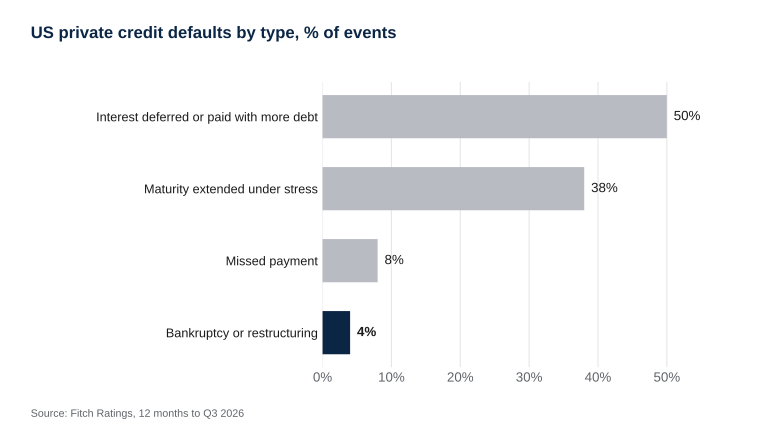
Very few of those defaults are bankruptcies. Most are companies that paid interest with more debt or were given more time to repay. In other words, many borrowers are buying time. That works if business improves. If it does not, the losses grow, and because the loans are valued with models, investors may discover them late and all at once, just when everyone wants to leave.
The problem does not stay inside the fund
Banks are closer to this world than the word "shadow" suggests. US banks have lent $1.7 trillion to non-bank financial firms, and almost half of what they have committed goes to private equity funds and to lenders such as private credit funds. They compete with these funds for borrowers and, at the same time, lend to them. Insurers, for their part, own many of the loans.
Even so, the direct risk looks limited. In a severe scenario simulated by the ECB, European insurers would take the largest losses, and banks would lose no more than 1.3% of their equity, because they usually lend to the funds with priority. The bigger risk, according to the IMF, is that a wave of defaults spreads to corporate credit more broadly.
The first warnings
In September 2025, two US companies collapsed within days of each other: First Brands, a car parts maker with more than $10 billion in liabilities, and Tricolor, a lender to car buyers with weak credit histories. Both cases involved accusations of fraud, so they say little about the market as a whole. What they did show is how much debt a company could pile up in an opaque system before anyone noticed, and that the losses also reached banks and funds linked to firms such as Jefferies and UBS.
In 2026 the test came from investors. In the first quarter, many asked for their money back at once, driven largely by fears that artificial intelligence could hurt software companies, which receive about a fifth of direct lending, and by doubts about lending standards after the failures of 2025. Blue Owl's technology fund, the most exposed to software, received requests for 40.7% of its shares.
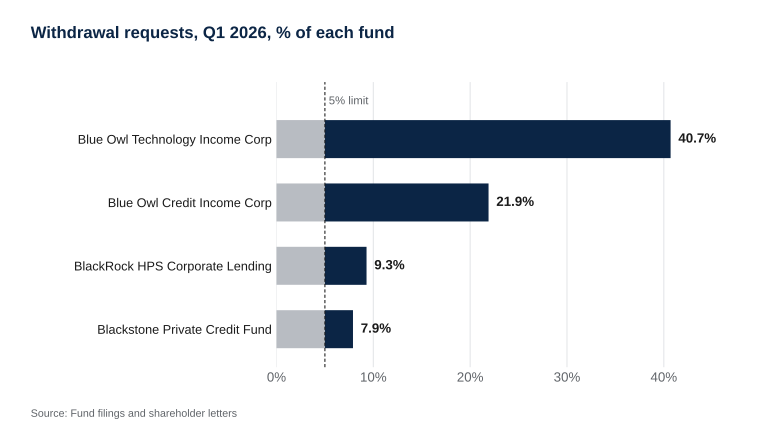
The funds reacted differently. Blackstone raised the limit of its flagship fund to 7% and added its own money so that everyone was paid. BlackRock's HPS fund paid out the usual 5% and left the rest waiting, and Blue Owl capped both of its funds at 5%. Across the market, more money left these funds than came in for the first time, according to Robert A. Stanger & Co., and by June $9.6 billion of requests were waiting in line. It was not only small savers who asked to leave, though: according to Blue Owl, the requests also came from some large institutions.
In one sense, the system worked: the limits stopped a rush for the exit. But, as Deutsche Bank points out, a limit on withdrawals does not give a borrower the ability to pay its debt. It can stop a panic, but it cannot remove a loss.
“Risks often shift rather than disappear.”
Deutsche Bank Research Institute, November 2026
How could a crisis spread?
Putting together what the IMF, the ECB and Deutsche Bank describe, the scenario that worries regulators would unfold like this:
- The shockA recession, interest rates that stay high for longer, or a blow to a large sector such as software.
- Borrowers struggleMore companies pay interest with new debt or ask for more time, and some fail.
- Losses surface lateBecause the loans are valued with models, the losses show up late, and then all at once.
- Investors runInvestors in semi-liquid funds ask to leave. Funds hit their limits, and new money stops coming in.
- The spiralWithout new money, funds cannot refinance their borrowers, so more companies default.
- ContagionThe losses reach the insurers that own the loans and, to a lesser extent, the banks that lend to the funds.
- Credit crunchMid-sized companies that depend on this credit find it much harder to borrow.
The IMF has estimated part of the timing: in a moderate shock, a typical semi-liquid fund paying out 5% every quarter would run out of liquid resources in five to seven quarters, and managers might close the door before that.
It could also be harder to stop than a bank run like the one at Silicon Valley Bank in 2023. As Deutsche Bank notes, a central bank can lend cash to calm a panic, but cash cannot repair real losses, and deciding which opaque fund deserves help, and who should bear the losses, is much harder than rescuing a bank. With public debt higher than before 2008, governments also have less room to help.
Good signs and bad signs
Reasons for calm
- Most of the money cannot run. Most private credit is locked in for years, and the funds that allow withdrawals are still a small part of the market.
- Banks are well protected. They usually lend to the funds with priority, and even in a severe scenario their losses would be small.
- The limits held. Funds have paid out up to their caps, none has suspended withdrawals, and very few defaults so far are bankruptcies.
Reasons for concern
- Borrowers are buying time. Defaults are at a record, and most are interest paid with new debt or deadlines pushed back.
- The money is leaving. Withdrawal requests are still far above the limits, and new money into these funds fell 82% in a year.
- Nobody sees the whole picture. Regulators can only find part of the market in their data, and banks' links to non-banks have turned out larger than earlier data suggested.
What are regulators doing?
Regulators are taking two different approaches, and both go back to the same mismatch.
Europe has gone after the structure itself. Under the revised EU fund rules, known as AIFMD II, which apply from April 2026, a fund that makes loans must in principle be closed-ended, so investors cannot ask for their money back early. It can only offer withdrawals if it convinces the regulator that it can manage the liquidity. These funds also face a cap on how much they can borrow, lower for those that allow withdrawals.
The US and international bodies are focusing on seeing better. The Fed now includes private credit in the official US financial accounts, and new reporting has shown how much banks have really committed to non-banks. The IMF asks supervisors to close data gaps, to run stress tests on banks and, where possible, on non-banks, and to make sure losses show up in loan values on time, so that late surprises do not set off waves of withdrawals. At the same time, US policy is opening the door wider to individuals: an executive order signed in August 2025 asked regulators to make room for private credit and other private assets in 401(k) retirement plans.
None of these measures asks funds to hold capital the way banks do. That fits the logic of the system: a fund's investors accept that they can lose money, while a bank uses the savings of depositors who can leave tomorrow. The open question is whether that logic still holds as these funds reach more individuals, and as banks remain among their lenders.
What can we take from all this?
Deutsche Bank does not say that a crisis is coming. Its point is that banks are much stronger than in 2008, and that part of the risk has moved to places with lighter rules and less visibility. Private credit is the clearest example.
The problem is not its size. Most private credit is financed with money that cannot leave quickly. The weak point is the part that has taken on the old banking promise, money back at short notice, without the banking safety net, at a time when more borrowers are buying time. If losses appear, withdrawal limits can stop a run, but not the loss itself, which would fall first on the funds' investors, more and more of them individuals, and then on the insurers and banks behind them.
So the signs to watch are specific: whether defaults turn from delayed payments into real losses, whether withdrawal requests fall back below the limits, and whether regulators get a full view of who is exposed. For now, the evidence points to a market under stress, not to a crisis. Deutsche Bank's authors borrow an idea from the economist Hyman Minsky: stability is destabilising, because the longer things go well, the more risk everyone is willing to take. Almost two decades without a major financial crisis is good news, and it is also when risks are easiest to overlook.
This article reflects my personal views and is for information only. It is not investment advice.
Sources
- Deutsche Bank Research Institute (H. Allen, P. Sidorov, C. Siazon), Why hasn't there been a major financial crisis in recent years?, 3 November 2026
- elEconomista, V. Nieves, Deutsche Bank admite que la banca ha perdido el control de las finanzas…, 10 November 2026
- Financial Stability Board, Global Monitoring Report on Nonbank Financial Intermediation 2025, and the 2020, 2019 and 2018 editions
- IMF, Global Financial Stability Report, April 2026 and October 2026, chapter 1
- European Central Bank, Stress in global private credit markets and its implications for euro area financial stability, May 2026
- Federal Reserve, Introducing Private Credit into the Financial Accounts of the United States, October 2026; Private Credit Growth and Monetary Policy Transmission, August 2024; Financial Accounts of the United States, table S.129.3
- Federal Reserve Bank of Boston, Bank Lending to Non-Bank Financial Intermediaries, July 2026
- Fitch Ratings, U.S. Private Credit Default Rate Remains Elevated in 3Q26, 29 October 2026 (press release as published by ABL Advisor)
- Directive (EU) 2024/927 (AIFMD II), Official Journal of the European Union, 26 March 2024
- The White House, Executive Order 14330: Democratizing Access to Alternative Assets for 401(k) Investors, 7 August 2025
- Bloomberg, Deutsche Bank Flags $30 Billion Exposure to Private Credit, 12 March 2026; BlackRock $26 Billion Private Credit Fund Limits Withdrawals, 6 March 2026; Blue Owl Limits Redemptions on Private Credit Funds, 2 April 2026
- Morningstar, Blackstone Private Credit Aims to Calm Investor Jitters, March 2026
- Semafor, Blue Owl faces withdrawal flood as private credit jitters persist, 2 April 2026
- InvestmentNews, Fallout from First Brands bankruptcy ripples through credit markets, October 2025, and on Robert A. Stanger & Co. data for non-traded BDCs: first quarter and first half of 2026